


In Morocco the standard international language indicator points the wrong way
The OECD indicator for students who speak a language other than the test language at home identifies a disadvantaged minority almost everywhere. In Morocco it identifies 88% of the cohort, and they score 42 points above the minority it is supposed to protect.
Summary
International indicators are built to travel. Most of them do. The indicator for a home language different from the language of assessment is one that does not, and Morocco is where it breaks most visibly.
In a European system this indicator picks out a migrant minority studying in the majority language, and a gap of twenty or thirty points below the majority is the expected result. In Morocco the assessment language is Modern Standard Arabic, which is the language of schooling and of formal writing and is nobody’s first language at home. Moroccan Arabic and Amazigh are.
What the data shows.
- 87.9% of Moroccan 15-year-olds report speaking a language at home other than the language they were tested in. The indicator identifies the overwhelming majority, not a minority.
- They scored 42.3 points ABOVE the 11.9% who report speaking the test language at home (3.6), and 39.5 points above once socio-economic status is held constant.
- The gap that does matter is grade position. 49.5% of Moroccan 15-year-olds were still in primary or lower secondary education, scoring 70.5 points below those who had reached upper secondary (4.2), and 65.5 points below net of socio-economic status.
- Morocco’s socio-economic gradient is unusually flat at 13.5 points per unit (2.2), with a published OECD figure of 8% of achievement variance accounted for. Where a whole distribution sits low, socio-economic status has less room to discriminate.
The practical warning is simple and applies well beyond Morocco. An indicator that is valid on average across eighty systems can be invalid, or reversed, in a particular one. Before quoting a cross-national indicator about your own country, check what it is actually measuring there.
Why this is the question for Morocco
Morocco’s language-of-instruction policy has been contested for a decade, through the 2016 shift towards French for scientific subjects and the ongoing formalisation of Amazigh. Anyone arguing that case from PISA data will reach for the home-language indicator, and will find a number that appears to say the opposite of what everyone in a Moroccan classroom knows.
The reason is a definitional one rather than a data error. The students reporting the test language at home are those who name Modern Standard Arabic as their household language. That is an unusual thing for a Moroccan family to report, and the group that reports it is small and, on these data, socio-economically and academically distinctive in ways that have nothing to do with a language advantage.
The correct conclusion is not that language does not matter in Morocco. It is that this variable does not measure it. PISA offers no variable that separates Moroccan Arabic from Amazigh from Modern Standard Arabic in a way that maps onto the policy question, and a note that pretends otherwise is inventing evidence.
The data, and how it was handled
6,867 students in 178 schools, representing a weighted population of 454,986 15-year-olds, from the OECD’s PISA 2022 student and school Public Use Files. National mean in mathematics: 364.8 points (SE 3.4).
Achievement is imputed rather than measured, so estimates are pooled by Rubin’s rules over all ten plausible values. The sample is clustered in schools, so standard errors come from the 80 Fay-adjusted replicate weights the OECD ships for the purpose. Omitting either understates the uncertainty, usually by a factor of two or more.
Before presenting anything new, this note reproduces figures the OECD has already published for this country.
| Published by the OECD | Published | This analysis | SE |
|---|---|---|---|
| Advantaged minus disadvantaged, mathematics | 43 | 43.22 | 7.15 |
| Share of mathematics variance accounted for by ESCS | 0.08 | 8.5% | 0.026 |
Source: OECD, PISA 2022 Results (Volume I and II) Country Note: Morocco, published 5 December 2023, https://www.oecd.org/en/publications/pisa-2022-results-volume-i-and-ii-country-notes_ed6fbcc5-en/morocco_10dfcb74-en.html (read 6 August 2026)
The indicator, and why it inverts
The full breakdown, with socio-economic profile alongside performance.
| Language spoken at home | Students | Share | Mean, mathematics | SE | Mean ESCS |
|---|---|---|---|---|---|
| Test language at home | 833 | 11.9% | 327.5 | 2.9 | -1.98 |
| Another language at home | 6,024 | 87.9% | 369.8 | 3.4 | -1.76 |
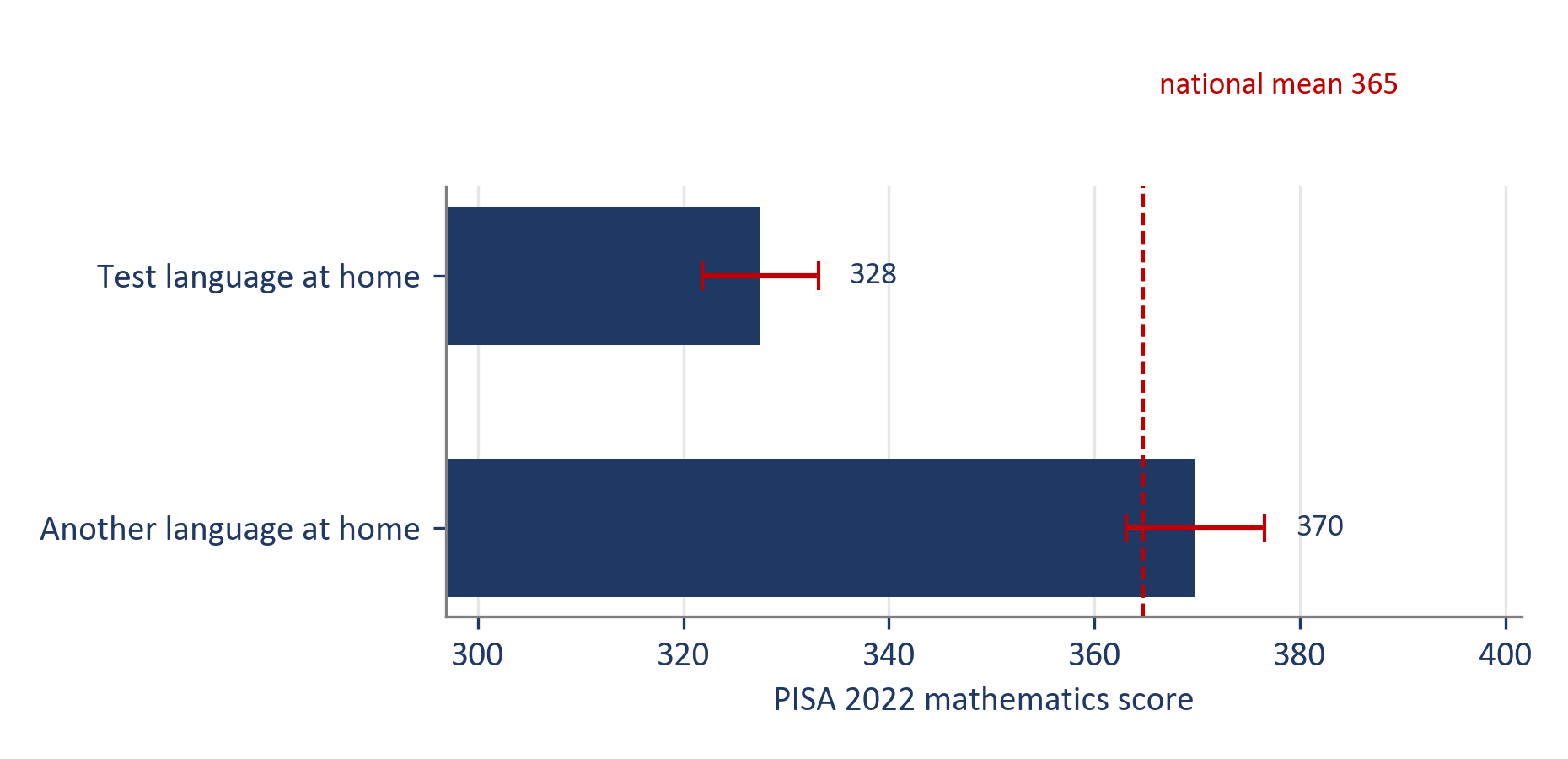
The direction is the finding. Adjustment for socio-economic status does not reverse it or shrink it; the group flagged by the international indicator as linguistically disadvantaged outperforms the reference group by a wide margin in Morocco, and does so at a similar socio-economic level.
| Contrast | Unadjusted | SE | Net of ESCS | SE |
|---|---|---|---|---|
| Another language at home minus Test language at home | 42.3 | 3.6 | 39.5 | 3.1 |
The honest interpretation is that in Morocco this variable separates families by how they describe their own language rather than by whether their children face a language barrier at school. Since essentially the whole cohort learns in a language other than the one spoken at home, the barrier, whatever its size, is close to universal and therefore invisible to a comparison between Moroccan students.
This is the kind of finding that only appears when someone runs the analysis on the microdata and looks at the direction of the coefficient rather than its significance.
The gap that does matter: where a 15-year-old is in the system
Half of Morocco’s 15-year-olds had not reached upper secondary education at the time of the assessment. In a system with substantial grade repetition, the grade a student has reached by 15 is itself an outcome, and it separates the cohort more sharply than anything else measured here.
| Programme orientation | Students | Share | Mean, mathematics | SE | Mean ESCS |
|---|---|---|---|---|---|
| Primary or lower secondary | 3,463 | 49.5% | 329.1 | 1.7 | -2.12 |
| Upper secondary general | 3,404 | 50.5% | 399.6 | 3.7 | -1.46 |

| Contrast | Unadjusted | SE | Net of ESCS | SE |
|---|---|---|---|---|
| Primary or lower secondary minus Upper secondary general | -70.5 | 4.2 | -65.5 | 3.5 |
Adjusting for socio-economic status leaves 65.5 points, so this is not simply poverty under another name. Holding school location constant as well leaves the location gap at 5.7 points, which says that most of Morocco’s apparent rural disadvantage runs through grade position rather than around it.
That is a policy-relevant reframing. A rural school effect and a rural retention effect call for different responses, and these data point at the second.
Can this comparison be trusted? A measurement audit
Test scores are placed on a common scale by design. Questionnaire indices are not. Comparing an index across groups assumes the items mean the same thing in every group being compared, and that assumption is testable. It is usually not tested.
Given that the lead finding is about an indicator behaving unexpectedly, testing whether the questionnaire construct behaves consistently across the same groups is not optional. If the belonging items also function differently for the two language groups, the whole comparison becomes uninterpretable rather than merely surprising.
| Model | Chi-square | df | CFI | RMSEA | SRMR | Decision |
|---|---|---|---|---|---|---|
| Configural | 1139.53 | 18 | 0.701 | 0.180 | 0.095 | reference |
| Metric | 1144.49 | 23 | 0.681 | 0.165 | 0.101 | rejected |
| Partial-metric | 1102.54 | 21 | 0.692 | 0.169 | 0.100 | partial |
| Scalar | 1197.45 | 28 | 0.675 | 0.150 | 0.103 | rejected |
Measurement invariance of the sense of belonging at school block across language spoken at home. N = 6,517. Estimator MLR. Decision rule after Chen (2007).
Verdict. Only partial metric invariance was reached (freed BEL=~ST034Q03TA, BEL=~ST034Q02TA); cross-group comparison of latent relationships is limited. The categorical re-run reached metric invariance.
The cascade stops at partial metric. Equal factor loadings could not be sustained across the two language groups without freeing parameters, and equal intercepts were never reached. In plain terms: the belonging items do not carry the same meaning for the two groups, and their means cannot be compared at all.
That is a finding rather than a failure, and it doubles the note’s central point. The grouping variable does not mean in Morocco what its international label says, and the questionnaire construct does not behave the same way across the groups it defines. Anyone who has quoted a Moroccan belonging or wellbeing figure broken down by home language has quoted a number the measurement does not support.
Absolute fit is also poor in every group, with a configural CFI near 0.70. The six-item belonging block is not a clean single factor in Morocco, which is a separate problem from non-invariance and compounds it.
What follows
Three statements are supported and narrow enough to defend.
- The OECD home-language indicator should not be used to describe language disadvantage in Morocco. It identifies 87.9% of students and points in the opposite direction to the policy concern it is normally used for.
- Grade position at 15 is the largest measured divide in Moroccan schooling, at 65.5 points net of socio-economic status, and it absorbs most of the apparent rural gap.
- Morocco’s flat socio-economic gradient should be read with care. A flat gradient in a low-performing distribution can reflect a floor effect rather than an equitable system.
The analysis Morocco actually needs on language is not available from PISA. It requires an instrument that distinguishes Moroccan Arabic, Amazigh varieties, Modern Standard Arabic and French as languages of home, instruction and assessment separately. That is a design question for a national study, and it is the kind of thing a comparability audit is for: to establish what the existing data cannot answer before someone answers it anyway.
What this note does not claim
- No trend statement. Comparing 2022 with an earlier cycle requires the published link error for that cycle pair to be carried in the variance. No such comparison is made here.
- No causal claim. Every difference is an association measured at one point in time. “Net of ESCS” means one measured index is held constant, not that other things are equal.
- The invariance cascade is fitted without the replicate-weight design, which is standard practice and is stated rather than left implicit.
- No variable in the public file distinguishes Moroccan Arabic from Modern Standard Arabic in a way that supports the policy question. The note reports what the available indicator does and explicitly declines to substitute it for a measure of language disadvantage.
- Grade position at 15 is an outcome of prior schooling, not a treatment. The gap between grade groups partly reflects the selection that produced them.
Method and reproducibility
Data: OECD PISA 2022 Public Use Files, downloaded from webfs.oecd.org on 6 August 2026. Point estimates pooled over ten plausible values by Rubin’s rules; sampling variance from 80 Fay-adjusted replicate weights with a Fay factor of 0.5, computed per plausible value and averaged; imputation variance inflated by (1 + 1/M). Invariance tested as a staged configural, metric, scalar and strict cascade in lavaan with full-information estimation for the rotated questionnaire design, plus a categorical sensitivity re-run on pairwise-present data.
Subgroups are derived from variables the OECD codes identically in every participating system, so this note was produced without country-specific recoding. Where a country’s own sampling strata carry a more policy-relevant structure, that structure is used instead and the note says so.
Enquiries about reproducing the analysis are welcome at milos@centerforpsychology.me. Commissioning the equivalent for another country is consulting work, handled by AdriaMont Consulting DOO at milos@adriamont.me.
All country notes in this series
About
Dr Milos Kankaras is a psychometrician and policy analyst with more than twenty years of international large-scale assessment work, including with the OECD, UNESCO and Eurofound. His published specialism is measurement equivalence and cross-cultural comparability. He holds a PhD in social sciences from Tilburg University.
This note is one of a series of country notes produced from the same analysis code. Published by the Center for Psychology, Podgorica. The Center for Psychology and the AdriaMont Institute are both operated by AdriaMont Consulting DOO, Cetinjski put 36, 81100 Podgorica, Montenegro. Commissioning enquiries go to milos@adriamont.me.
Dr Milos Kankaras | milos@centerforpsychology.me | miloskankaras.com | centerforpsychology.me | ORCID | LinkedIn